A learning subscription or fixed access period is useful only if it overlaps with time you can actually practice. Someone paying for a class still needs to evaluate that practical fit separately from the transaction. Start with the access window and your realistic study opportunities, not the platform’s advertised library size.
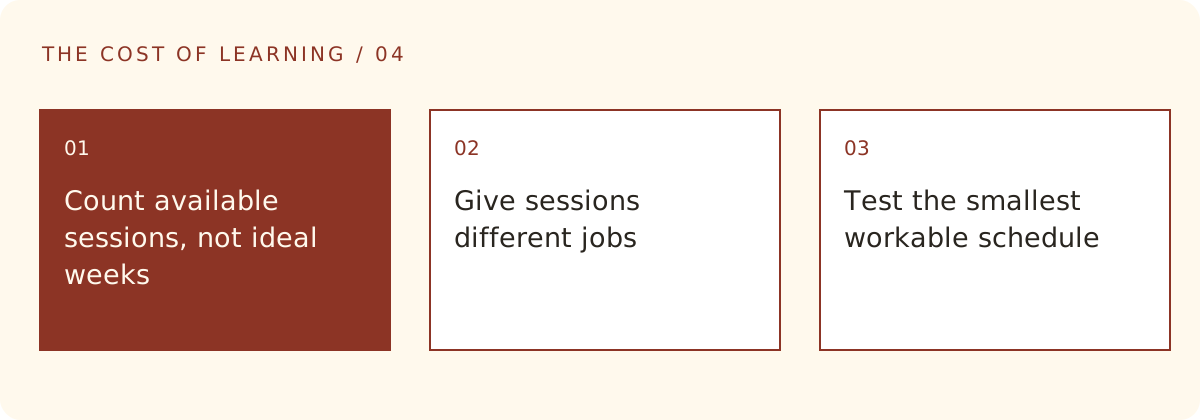
Count available sessions, not ideal weeks
Suppose an invented course provides access for eight weeks. A learner expects two forty-minute sessions each week, but knows that two weeks contain no usable study time. That produces twelve planned sessions and eight hours, not sixteen sessions. The point is not to maximize every spare minute. It is to avoid purchasing a schedule that exists only on paper.
Check whether the access period begins at purchase, activation or the first class. Ask whether downloads remain usable afterward and whether feedback deadlines occur before platform access ends. These are provider-specific terms. Do not assume a public example describes a real school.
Give sessions different jobs
A first session may be orientation, a second guided practice and a third independent application. Treating every session as interchangeable can make the plan look easier than it is. Include time to find files, read feedback and retry a difficult exercise. Those are parts of learning, not proof of inefficiency.
If the course requires a particular computer, workshop or internet connection, place that requirement beside the session. An hour away from the necessary equipment may not be usable practice time. Consider accessibility and fatigue without turning the plan into a judgment about personal discipline.
Test the smallest workable schedule
Before paying, try one ordinary practice session with a free sample or an unrelated task that uses the same setup. You are testing the time and environment, not certifying the course quality. Notice whether interruptions, travel or equipment availability change the plan.
If the schedule does not fit, possible choices include a later start, a different format, a shorter course or no purchase yet. Ask about extensions before relying on them; an extension might cost money or might not exist. A realistic calendar protects the usefulness of the purchase without promising that a particular number of study hours will produce a particular skill.
Continue the comparison
Put the cost of attending beside the cost of admission
Build a training preapproval matrix before enrolling
Method and scope
This is an original worked planning guide. All amounts, schedules and providers in its examples are fictional unless a source is explicitly identified. The calculations explain relationships, not a personalized financial recommendation. No private account or provider payment flow was tested.