A course price is easier to compare when the required materials have their own line. Before paying, do not assume that a tuition amount is the total purchase or that every supplier accepts the same payment route. Build an itemized learning budget before deciding whether the course fits your circumstances.
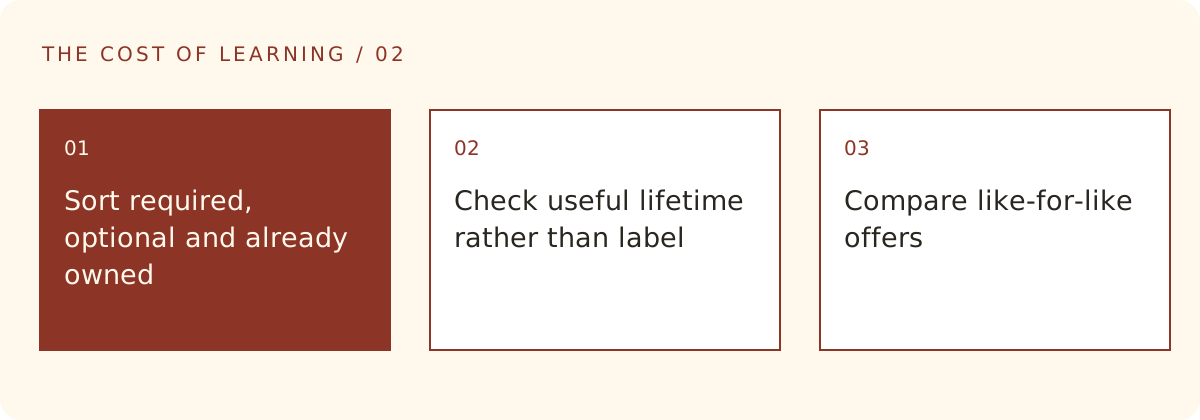
Sort required, optional and already owned
Ask for the current materials list, including editions, software versions, consumables and any equipment specifications. A recommended upgrade is different from a required item. A device you already own counts as available only if it meets the stated requirements and can be used when you need it.
Consider an invented workshop with $180 tuition, a $35 workbook and a $25 materials kit. The known required purchase is $240. An optional $45 reference book does not belong in that minimum, but it belongs in a separate choice column. Calling all four items “the course cost” would hide which decision is actually optional.
Check useful lifetime rather than label
A reusable tool and a consumable supply behave differently. Ask how much material a normal exercise uses and whether replacements are included. A software license may expire before you finish practicing. A borrowed device might be available only on certain days. These constraints can matter more than a small difference in price.
Do not price uncertain items at zero. Write “not quoted” and identify who can answer. If a school says that a kit is included, ask what is inside and whether the contents are sufficient for the required work. Save the answer with the course version or date, not as a universal promise about future enrollments.
Compare like-for-like offers
Course A and Course B should be compared using the same definition: tuition plus mandatory materials for the intended task. Keep optional items separate. Do not count the same workbook twice when one quote already includes it. If a used item is allowed, confirm the edition and whether a one-time access code is needed before treating it as an equivalent substitute.
End with a short total and a short uncertainty list. A $240 known total plus an unquoted software requirement is not a $240 all-inclusive offer. The useful outcome is a clearer purchase decision, not a claim that education must always be bought at the lowest price. Teaching quality, accessibility and completion requirements still need their own assessment.
Continue the comparison
An exam voucher and a passed exam are different purchases
Put the cost of attending beside the cost of admission
Method and scope
This is an original worked planning guide. All amounts, schedules and providers in its examples are fictional unless a source is explicitly identified. The calculations explain relationships, not a personalized financial recommendation. No private account or provider payment flow was tested.